
The corrosion inhibitor market
Demand for industrial protection shaped by aging infrastructure, more challenging production conditions and the need for efficient operations.
01 / Market size & growth
A growing need for corrosion protection
- Estimated market size · 2025–2026
- $9.3–11.18bn
- Forecast market size · 2033–2034
- $13.3–16.1bn
- Reported annual growth range (CAGR)
- 4.2–5.4%
Estimates and forecasts reproduced from the supplied market brief. The ranges combine its stated base years and forecast horizons.
Download the market brief (DOCX)02 / Customer industries
Protection across essential industries
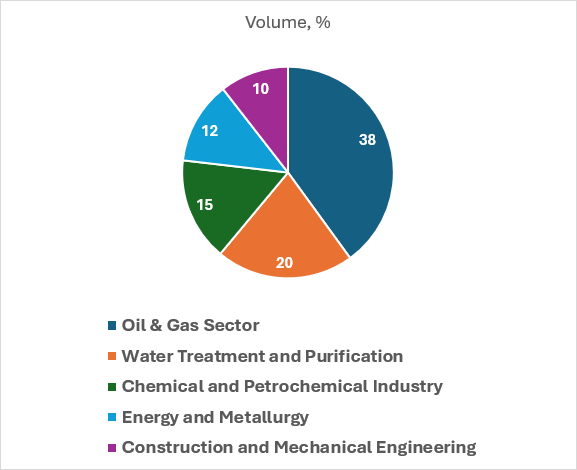
Oil & gas
Deepwater drilling, production with high H₂S and CO₂ content, and protection of main pipelines.
Water treatment & purification
Protection of cooling towers, boilers and closed-loop water systems in industry and public utilities.
Chemical & petrochemical industries
Equipment operating in aggressive acidic and alkaline environments at high temperatures.
Energy & metallurgy
Protection of steam turbines, boilers and heat exchangers against pitting and under-deposit corrosion.
Construction & mechanical engineering
Concrete additives for reinforcement protection and treatment of parts and metal structures.
How the market is segmented
By chemical composition
Organic inhibitors
The brief estimates a share of approximately 80–83%. Examples include amines, imidazolines, phosphonates and quaternary salts.
Inorganic inhibitors
Examples include chromates, nitrites, silicates and phosphates. The brief describes a declining share linked to environmental restrictions on certain compounds.
By mechanism of action
Anodic
Form a passivating film on anodic areas.
Cathodic
Slow down cathodic reactions.
Mixed / film-forming
The brief highlights their versatility and demand in oil and gas applications.
03 / Geographic demand
A global market led by Asia-Pacific
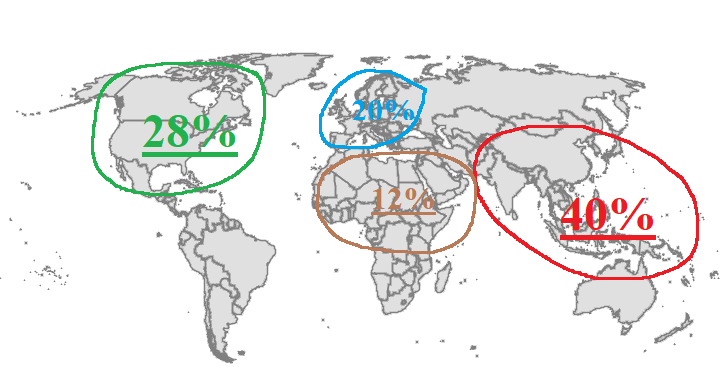
Asia-Pacific 37–40%
Expansion of chemical, energy and construction industries in China and India.
North America 25–28%
Shale oil and gas activity and aging infrastructure.
Europe 18–20%
Middle East & Africa 12–15%
The brief highlights large-scale oil production and desalination in the Middle East.
Approximate regional ranges as listed in the brief; not a normalized allocation of the global market.
04 / Technology & competition
Where the brief sees demand evolving
Lower-impact formulations
The brief identifies a shift toward biodegradable inhibitors based on plant-derived raw materials, amino acids and biopolymers.
High temperature and pressure
More demanding production conditions drive interest in heat- and pressure-resistant reagents, including hot synthesis technologies and thermostable polymers for temperatures above 150–200 °C.
Smart and sustained release
Microencapsulation can enable release of an active substance in response to changes in pH or mechanical damage.
Local production
The brief highlights supply-chain restructuring and the development of local reagent synthesis plants in the CIS, the Middle East and Asia.
Companies named in the brief
Names and groupings are reproduced as supplied.
- SLB (Schlumberger) / ChampionX
- Baker Hughes / GE
- Nalco Water (Ecolab)
- BASF SE
- Clariant
- Dow Chemical / DuPont
- Suez / Veolia Water Technologies
A focus on specialized industrial applications#
The market brief identifies opportunities for specialized manufacturers offering high-temperature formulations, low dosage and patent-backed technology. These priorities connect with the proposed COFLAS manufacturing platform and its integrated research laboratory.